
The Point of Medicine
A FORUM OF CHRISTIAN MEDICAL & DENTAL ASSOCIATIONS®
Lessons Learned from the West African Ebola Epidemic
June 10, 2026
By Richard A. Sacra, MD
This outbreak is an opportunity—an opportunity for Christian physicians, an opportunity for mission organizations, an opportunity for ordinary believers—to make a difference.

About 12 years ago, I was in Liberia helping to keep ELWA Hospital’s obstetric services open during the largest Ebola virus outbreak in history. On Friday, August 29, 2014, I was sitting in my little apartment and started feeling a chill come on. That was the beginning of a journey that carried me into our ELWA II Ebola Treatment Unit for three days, and then to the University of Nebraska’s Biocontainment Unit, where I spent three weeks recovering from the Zaire strain of Ebola. I praise God for sparing my life. I mourn the loss of several dear colleagues to Ebola.
As I’ve been following the news of a new outbreak of Ebola, centered in eastern Congo (DRC), this time due to the Bundibugyo strain (the rarest type—this is only the third outbreak of this strain), I think we can learn some lessons from the West African epidemic of 2014-2016, in which an estimated 11,325 people lost their lives.
I am in no way an expert on Ebola—I had the disease, but I’m just a family physician with some African experience, not a virologist.
This outbreak is an opportunity—an opportunity for Christian physicians, an opportunity for mission organizations, an opportunity for ordinary believers—to make a difference. We can respond through prayer, sharing accurate information, contributing materially to the effort and, if you are in a position to do so, volunteering to serve.
I’d like to summarize a few lessons learned from the West African Ebola epidemic. First, this virus infects caregivers first and foremost. It is spread through close, direct contact with the sick. Unlike viral illnesses such as measles or chickenpox, where the infected individual is most contagious during the first few days of infection, Ebola is not very contagious until the patient develops vomiting, diarrhea or bleeding, and even after death, the corpse is highly infectious. So mothers, siblings, spouses, good Samaritans, healthcare professionals and mourners are most at risk. The Americans infected during the previous outbreak included two nurses caring for a dying man at a hospital in Texas.
Secondly, the broader effects of Ebola on the healthcare system are just as impactful as the direct results of infection. In Liberia in 2014, most health facilities shut down or severely limited their services due to the risk to healthcare workers. Several facilities that tried to stay open had catastrophic losses among their staff. I would anticipate that, during this outbreak, the care of pregnant women, children and surgical patients will suffer, and numerous individuals could lose their lives due to illnesses that would normally respond to routine care. Women in labor, in particular, are at risk from closures or limitations of available care.
Thirdly, the normal dynamic of patient care is turned on its head. As physicians, we are used to being the ones in control of the situation, the ones being asked to comfort and inform our patients, who may be ill and even at risk of dying. With Ebola, suddenly both parties in the doctor-patient interaction are at risk. This changes the dynamic of how we interact with patients. Even the protective equipment we wear makes it harder to have a true conversation in which both parties are acknowledged and dignified. It becomes critical to remember our patients are fellow creatures, bearers of God’s image, and we need to find ways to affirm that in our interactions.1
Finally, we need to think of caring for Ebola patients, or working in the “Ebola zone,” as a volunteer enterprise. I noticed, both in the U.S. and in Liberia, that trying to get staff to work and provide care to individuals suspected of having Ebola infection required staff who were willing to serve and had been well trained. The team at the Nebraska Biocontainment Unit was a wonderful example of this competency and volunteer spirit. On the other hand, there were other scenarios, both in the U.S. and Liberia, where staff stayed home from work or provided poor care because they were not fully willing to experience the risk of contact with an Ebola patient. It is important for individuals who serve in a high-risk area to have frank conversations with their families and loved ones about the risks. It was a relief to me when I became ill to know that, before I left my home in the U.S. for Liberia, I had sat with my wife, had a frank conversation about the risk of Ebola and had a time of prayer. As believers, we also have the benefit of knowing this life is not all there is—no matter what happens to us in this moment, we will spend eternity with Christ.
As of this writing, there were already more than 900 suspected cases of Ebola virus disease and more than 220 deaths. There is no approved vaccine or treatment available for the Bundibugyo strain, though having developed successful treatments and vaccines for the Zaire strain does provide researchers a pattern to follow. And eastern Congo, where the outbreak is centered, has been a conflict zone for nearly a decade, creating unstable political and civil structures and impacting the government response.
I believe Christian healthcare professionals can make a positive impact by becoming fully informed about the current Ebola outbreak, by praying for and supporting efforts to provide care for the sick and to keep healthcare services going in this incredibly stressful environment in eastern Congo,2 and even by volunteering in some cases. This is a time when there is an unmistakable opportunity to be good Samaritans, or to pray for and support those who are doing so, as exemplified in Jesus’ parable (Luke 10:25-37).
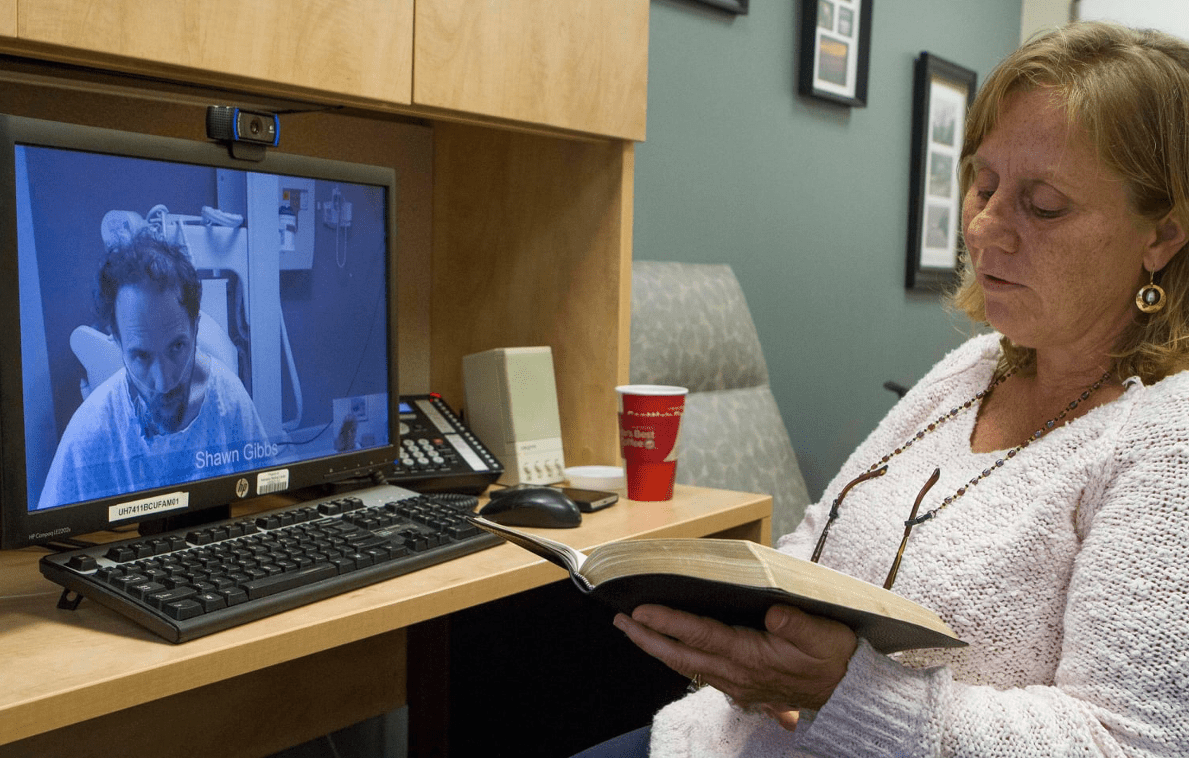
Debbie, Dr. Sacra’s wife, reading Psalms to him during treatment in Nebraska.
1These concepts are explored in more details in:
Fankhauser, John and Sacra, Rick (2019). Caring for Women in Labor at the Height of Liberia’s Ebola Crisis: The ELWA Hospital Experience. In Schwartz, D; Anoko, J. N; and Abramowitz, S (Eds). Pregnant in the Time of Ebola: Women and Their Children in the 2013-2015 West African Epidemic. Pp. 159-183.
2For one example of a missionary organization deeply involved in the Ebola response, consider Serge:
https://serge.org/blog/american-medical-missionary-tests-positive-for-ebola-in-democratic-republic-of-congo/ accessed May 26, 2026
What's The Point?
- What are other situations in which you put yourself at risk for the sake of another’s well-being? Please share your story.
- Are there situations in which we should not place ourselves at risk? What are some of those situations?
- Is this similar to Dietrich Bonhoeffer’s situation in Germany? Why or why not?
We encourage you to provide your thoughts and comments in the discussion forum below. All comments are moderated and not all comments will be posted. Please see our commenting guidelines.

Recent Articles


DISCUSSION FORUM
Join us for a vibrant conversation! This is a place to engage with others who see medicine not just as a profession, but as a calling — one that honors God, wrestles with real questions, and seeks truth with humility and purpose.